
Culture
Nights in the Hearts of the Fissure
Concerts, dance and pressure organs occupy halls excavated in rock.
Rock makes the hall
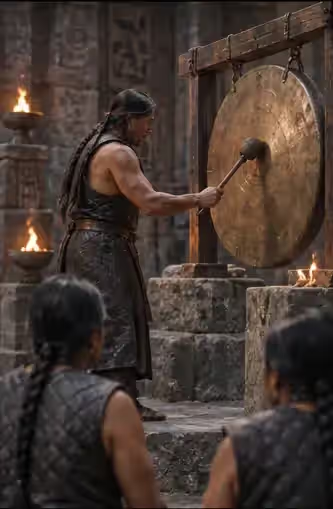
Great halls called Hearts of the Fissure are excavated around stabilised fractures. Square stages, circular shafts, steam, thermal glass and visible magma form their architectural repertoire. Performance takes place in a mountain shaped to contain force. Leisure spaces therefore carry the same questions of form and material as Korath’s other structures.
Instruments and resonant cavity
Pressure organs and enormous concerts belong to this nocturnal culture. Korath’s halls use rock cavities, resonant plates, percussion, anchored benches, quiet niches and wax earplugs. Sound engages the whole hall, but listening also includes places of retreat. Vibration becomes a cultural use of material and a practical concern for those hosting a crowd.
Waiting and the signal
Crowds alternate collective stillness, geometric movement and an explosion at the fissure’s signal. Dance therefore uses timing as much as space. Daytime discipline continues into a pleasure that can wait and then release together. Alcohol, clubs and music give nights a social intensity through which craftspeople, technicians and bourgeois circles show another side of their lives.
A night that follows the shifts
Korath does not all sleep at the same hour. The forges, the Breath crews and the garrisons work in shifts, and each shift has its night. The great halls therefore open several times a day depending on the district, and people speak less of “the night” than of “their outing”: the one that follows their shift, when the day of precision is over, whatever the hour on the public dial.
The crowds that meet there mix every walk of life. One meets apprentices who have just received their First Glass, soldiers on leave, journeymen in workshop gangs, well-known inventors recognisable by their supporters’ scarves, and bourgeois settled in the boxes. Foreigners are admitted everywhere, provided they respect the rule of the airlocks: people go in and out in groups, when the door warden allows it.
Small halls and district cellars
The Hearts of the Rift are only the summit of a much wider night culture. Every district has its music cellars, cut into old storerooms, where a handful of drummers and a râvèle player get a few dozen people dancing. Workshop taverns have their singing nights, when the club’s anthems are taken up in chorus. That is where most musicians are formed, long before the great halls notice them.
These small halls have their own safety rules, less spectacular than those of the great ones: a warden counts the people coming in on a tablet, one door must always stay clear towards the gallery, and the music stops at the first stroke of an alert gong. Korathi have a great time there, but none of them mistakes a district cellar for a place where the mountain could be forgotten.
Becoming a musician
Korathi musicians often come from the workshops. Drummers learn rhythm with the hammer, in forges where the blows answer one another in polyrhythm; players of the pressure organ are nearly all former Breath technicians, able to regulate a jet of steam as well as a note. The râvèle, an instrument with bronze strings stretched over a thick body, needs an apprenticeship of its own: its best players are celebrated like inventors.
A stage râvèle carries crystals of smoky quartz, cut and tuned to the hall where it is to be played, so that an instrument set for one Heart of the Rift sounds wrong in another. The craftsmen who cut these crystals treat their methods as workshop secrets. The popular papers follow musicians as they follow engineers: their transfers from one hall to another, their priority lawsuits over a riff, their quarrels with a rift master.
The dances of the rift
Korathi dance obeys geometry. Dancers stand in squares of four, sixteen or sixty-four, and each figure consists of turning these squares without letting them lose their shape. The figures take workshop names: the hinge, in which two dancers pivot around a third who stays still; the winch, in which the whole line steps back pace by pace before letting go; the gate, in which the square closes in a time counted out loud.
The motionless wait is the hardest figure. The whole hall must freeze and hold, sometimes for several minutes, until the signal of the rift; anyone who moves too early is booed and said to have “closed in seventeen”. Then comes the explosion, when the squares break apart at once, and only then does everyone dance as they please.
What foreigners say about it
Visitors rarely leave unmoved. Urnok merchants, used to festivals that follow the calendar of the registers, are surprised that so disciplined a city gives itself over to drink every evening. Volonians, whose Nights of Nacre are held on the water and serve as much to gather information as to have fun, find the Hearts of the Rift noisy and too hot, but admire the way the hall is run.
Korathi themselves see no contradiction in it. The pressure of the day produces the festivity of the evening, and the festivity is allowed only because people know how to come back from it on time. A workshop saying puts it their way: in the hall you may drop everything except the hour of the next morning.