
Institutions
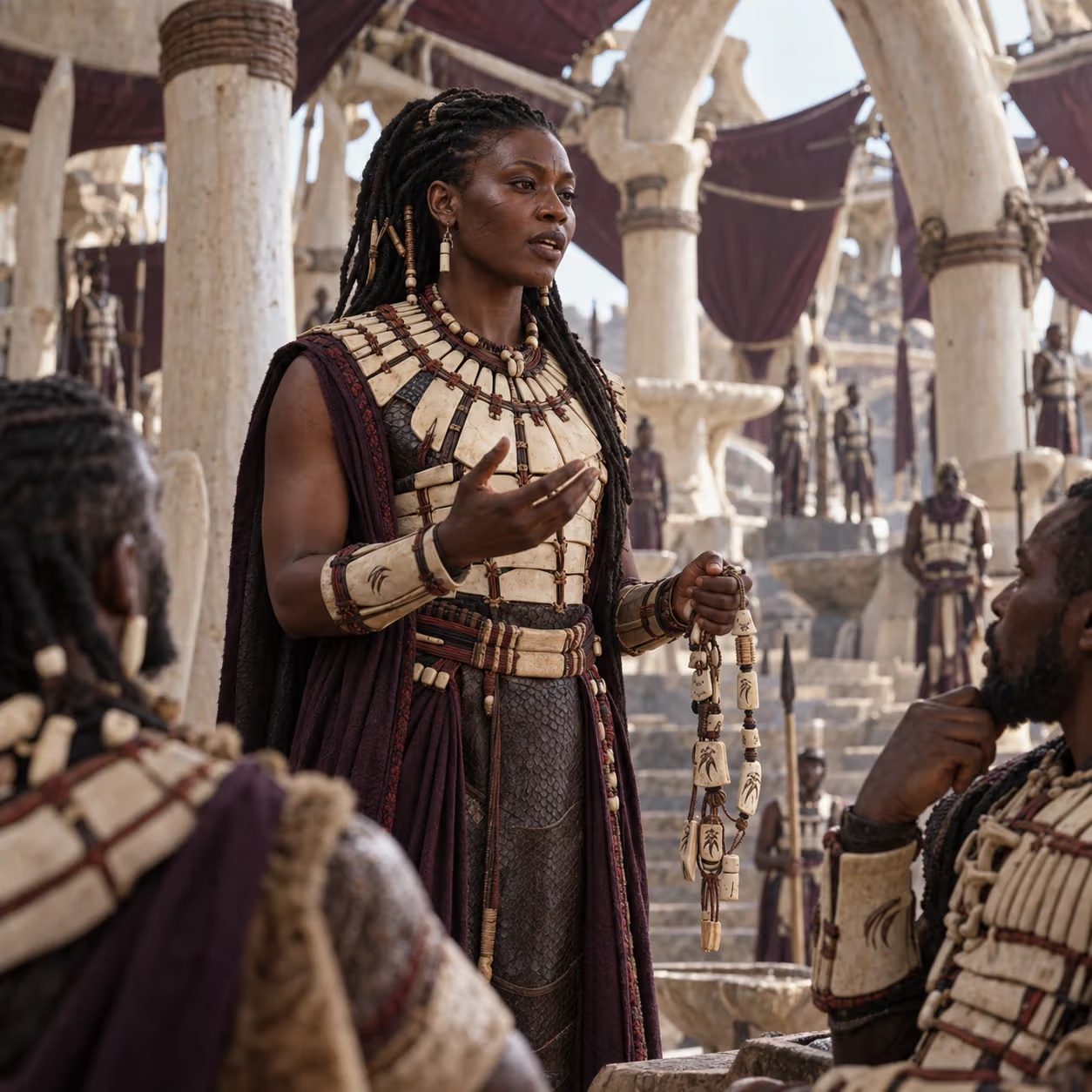
The Bone-Bearer
The keeper of Arkhan’s oral law: he holds pacts, precedents and debts in memory, and recalls them before the clans.
An oral constitution
The Bone-Bearer holds Arkhan’s oral law: he memorises pacts, precedents and debts. He can recall a commitment before the clans, and knows which precedents make a claim legitimate. Engraved bones, songs and witnesses carry this memory, which is said to stand in for an oral constitution. The bones he keeps are animal bones: in Arkhan, human bone never becomes material.
A memory that also serves violence
Its strength is also its weakness: an oral memory can be manipulated, and it serves violence as much as justice. The title is now borne by Drav l’Os-Sec, who wants debts to be acknowledged — and who can prove that a khan owes a share to a clan he despises.
Bones that help memory
The Bone-Bearer does not read: arḫán is not written. The animal bones he keeps carry notches, lines and small engraved figures that transcribe no sentence; each serves as an aid to memory for a particular song. The song holds the text of the pact, the bone keeps its trace and the number of its parts, and the witnesses guarantee that it exists. A solid claim combines all three: a bone that can be shown, a song that can be recited, living people who remember being there.
A Bone-Bearer’s bones travel in leather cases or on cords, sorted by lineage, by trail or by type of debt. The oldest, polished by the hands of several holders, come out only on great occasions. Like all bones in Arkhan craft, they are animal bones, and a Bone-Bearer who found a human bone among his own would hand it at once to the mortuary teams.
Recalling before the clans
When a claim is brought before the clans, the Bone-Bearer is called to state the precedent. He speaks in song, with the grammatical mark that designates what is known by tradition: to say something in -an is to set it in the clan’s memory, and the Bone-Bearer is the one who brings it back out. The debate then follows Arkhan grammar: each affirms with ha, contests with ho, and only the one presiding may close with hû. The Bone-Bearer never closes.
His power lies in what he chooses to recall. He cannot invent a pact the witnesses would deny, but he can change the order of an account, forget an awkward precedent, recall another at the right moment. That is why his memory serves violence as much as justice: proving that a clan owes a share can start a trail war, and keeping that proof quiet can prevent one.
Becoming a Bone-Bearer
One becomes a Bone-Bearer through a long apprenticeship. The most common custom is for a holder to choose, among the children of the trails, those who best retain the Racing Songs, an oral scripture of thousands of lines, and to keep them by him for years. Each evening the apprentice recites what he has heard during the day, then the old precedents, until he can state without error the debts of an entire trail.
The title is handed on before the clans, once the apprentice has proved he can hold a session without his master. Minor powers such as Chant-Long, keeper of a sacred oral memory, or Cercle-Chant, which guards epics and oral laws, often supply candidates, and some Bone-Bearers end their lives there. A Bone-Bearer who loses his memory loses his office but keeps his place by the fire: he is still consulted about the very old songs.
Drav l’Os-Sec
The present Bone-Bearer, Drav l’Os-Sec (Dry-Bone), knows the precedents that make a claim legitimate, and he wants debts to be acknowledged. He can prove that a khan owes a share to a clan he despises, which makes him an ally of the weak and a danger to the powerful. He is said to be better with crowds than with individuals, an admirable singer, able to work in bursts without sleep when a session approaches; he talks to himself while preparing his songs.
His byname is debated. Some link it to the dryness of his voice when he recites, others to the bleached bone he always wears at his belt, polished until no notch on it can be read any more: a precedent that he alone is supposed still to know. Drav confirms neither version.