
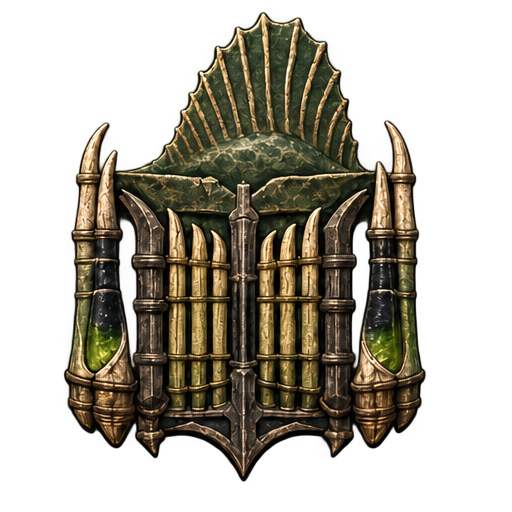
Institutions
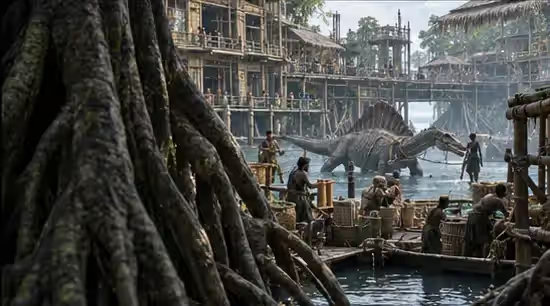
The Pact of Roots
The structural alliance linking N’Goro’s Master Carriers, hidden ports and Black Milk Houses; its exact legal form remains uncertain.
Three partners
The Pact of Roots is a structural alliance between the League of Master Carriers, the hidden ports and the Black Milk Houses. Its principle is firm; its exact legal form remains uncertain. The Pact organises access and resources without removing the rivalries between those it brings together.
The route that protects what it taxes
In the Bay of Roots, hidden ports, Master Carriers, flows of salt and venom, and smuggling sit side by side. A route taxed by a House is also a route it protects, and that protection can allow trade where official institutions do not provide the same services. Knowing that a port exists is not enough to enter it: relations with those who protect its access count as much as the ability to sail there.
Facing the centre
Under Sûma’s highly centralised power, the Black Milk Houses and the Insectophiles form a clandestine opposition. During quarantines, however, pragmatic cooperation and mistrust allow these networks and the Sap-Keepers to work together: a guide cannot make contaminated water safe merely by knowing the way.
What each partner brings
The Pact unites three partners who can do nothing without one another in the Bay of Roots. The League of Master Carriers brings barges, guides, knowledge of the passes and salt; the hidden ports bring anchorages, stores under the roots and quays that cannot be seen from the sea; the Black Milk Houses bring protection, credit and local justice, without which no foreign merchant would entrust a cargo to a labyrinth of roots. The League, said to be more than a thousand years old, is older than the Pact itself, and its House of Rith holds the great quays of Ngunya.
A cargo of venoms from the Silver Reeds bound for a Volonian ship shows how the shares work. The carriers bring it down the channels and answer for it on the way; a hidden port shelters it until the right tide; the House that holds that arm of the bay guarantees it will be neither stolen nor denounced, and takes its share. Each is paid at its stage. The Ngoro say the Pact is “a three-strand rope”: it holds as long as no strand rots.
An alliance without a charter
The Pact has never been given a settled legal form, and its members prefer it that way. There is no single charter, no text that could be brought before the Circle of Balances. The Pact lives in a host of particular undertakings: waterproof contracts drawn up by the scribes of Sceau-Boue, knotted cords exchanged between a House mother and a master carrier, oaths renewed at every change of water before a filter in the hidden ports.
The Circle’s jurists have long debated what it really is: a league, a custom, a tolerated conspiracy? Those involved take care not to decide. A Pact without a text cannot be denounced at a single stroke, nor produced as evidence before the centre. Each partner can deny the existence of the whole while honouring its own part, and that is doubtless what has let it endure under a power as centralised as Sûma’s.
Salt, venoms and the rest
Two goods make the Pact’s wealth. Salt first, which the freshwater marshes lack: it preserves fish, goes into several remedies and serves as small change in inland markets. Then venoms, and with them antidotes, glues and anti-rot, which the whole world buys because without them tendons, leathers and bone cements rot before battle. The Pact holds the routes by which part of these products leaves the country without passing through the Control Basins.
The rest is smuggling in the strict sense: uncontrolled Black Milk, hides of protected species, live insects, sometimes stolen clutches that minor powers such as Œuf-Fange slip through. The Houses’ Code forbids selling a poison whose counter-flask one refuses, and most partners abide by it, if only to keep the Sap-Keepers from closing the bay. The others take the risk, and sometimes pay dearly for it.
The Pact in war
In wartime the Pact becomes one of the keys to the coast. Its hidden ports shelter barges and wounded when the estuary is threatened; its carriers know the passes that large ships cannot use; its Houses know who is buying what, and therefore who is preparing for what. A foreign fleet that ignores the Pact finds a bay without pilots, beacons gone dark and channels where its hulls strike bottom at low tide.
For Muu-Shanga this strength is also a worry. The Pact owes nothing to the Circle, and its Houses belong to the clandestine opposition; nothing guarantees that a pass closed by order will not be reopened for payment. During quarantines pragmatic cooperation wins out, because a contaminated water ruins everyone. During a war each side watches the other. The Pact has never declared a side, and that may be its only rule, written nowhere.