

Religion and rites
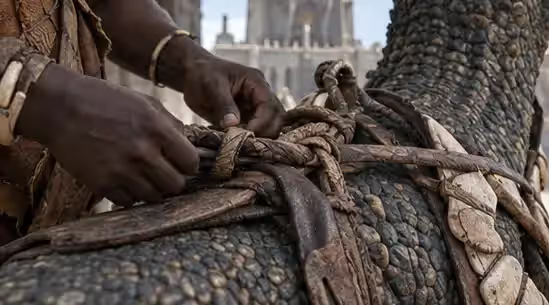
The Counting of Knots
An Arkhan evening gathering where the Racing Songs are recited and lineages and mount debts are knotted onto saddle cords.
The archive of a people without books
The Counting of Knots (Comptage des Nœuds) is the festival of the Arkhan archive. The Racing Songs are recited, and genealogies and mount debts are knotted onto saddle cords. The cords are stretched from saddle to saddle; old singers tell over the lineages. A cut knot cancels a debt or disowns a lineage: the gesture counts as an act.
In the evening, around the saddles
The festival is held at camp in the evening, with low fires and saddles set up in a circle. Families gather by clan; children learn the knots on their elders’ laps. The cord carries a material sign, the song keeps the names and their order: the memory of the trail needs both.
The order of the evening
The Counting follows an order that is never changed. It begins with the beasts: the keepers of lineages recite the genealogies of the mounts, the year’s births, the beasts that died, and knot for each what must be knotted. Then come the people: births, deaths, unions, and entries into the clan, those of children who have become hunters and those of captives who have become sons of the trail. Debts come last, mount debts, meat debts, bets from the Great Race, and that is when the evening heats up.
The Porte-Os and the oldest singers preside. They do not judge: they say what the Chants and the cords contain, and the clan acknowledges or contests. The festival is held once a year, at the end of the season of gatherings, when everyone has come back to camp.
Reading a cord
A saddle cord is read with the fingers as much as with the eyes, and the elders read it in the dark. A single knot marks a debt, a double knot a lineage tie; the gap between two knots tells the time elapsed, and a coloured thread wound around a knot indicates the clan concerned. The cords of a great family end up as long as several outstretched arms, and new ones are added as the old ones fill. Children learn first to untie, then to retie the knots of their own family; being able to knot one’s lineage without help is one of the first signs that adulthood is near.
During the Counting the cords are stretched from saddle to saddle around the fire, so that the whole circle is linked. Cords too worn to be carried are not thrown away: they are entrusted to the Porte-Os, who keeps them with the engraved bones of the clan’s memory.
Cutting a knot
The most awaited gesture of the evening is the cut knot. It has two opposite meanings, and the crowd always knows which before the blade falls. When the creditor cuts, before witnesses, a debt is extinguished: people applaud, and the debtor often offers a meal. When the head of a family cuts, with the elders’ agreement, a lineage is disowned, and the name of the one it designates is no longer sung in the clan.
The cut is made with a small blade of tooth, never with metal. A cut knot can be retied later, if a family is reconciled; the cord nonetheless keeps the mark of the cut, and anyone can feel it under the fingers. Hence the expression used for a broken pact: “cutting the cord”.
What becomes chant
The Counting also has a role in the language. Arḫán distinguishes what one has seen, what one has read in a trace and what one knows through the chant. A fact told by a witness is first spoken with the mark of what has been seen; once knotted and recited at the Counting, it passes into the register of the chant and becomes something the clan knows.
That is why the bitterest disputes of the evening concern not so much the debts themselves as what deserves to enter the clan’s memory. A contested deed may wait several Countings before being sung, and some never are: their authors then keep a witnesses’ glory, spoken in -ek and forgotten along with them.