

Culture
Writing that binds a responsible person
Glyphs, tablets and the language of proof give duties a lasting form.
The Scale Script
Urnâk has a Scale Script made of chevron glyphs traced on tablets. Writing gives duties and certified matters a support. It belongs to a civilisation of roads, reserves and archives: an inscription can be consulted when the people involved in an act are no longer in the same place.
Rouleaux, registre et encrier sur un bureau
Vue de détail.
Who answers for the thing
Urnâk speech distinguishes the responsible person, the duty and the degree of guarantee. The markers -ka, -mu, -ri and -sha belong to this vocabulary; -vek indicates something recorded or certified. This language expresses different responsibilities within a single sentence. Calling a road risky and a reserve guaranteed do not involve the same knowledge.
An entry follows the work
Trade Lines are addresses of responsibility within production chains. In Sarnor or Orlantis, recording a name distinguishes keeping reserves, treating material and transporting it. Being near a product does not establish who answers for it. Writing therefore connects an object with the function responsible for it.
Tablets, egg paper and engraved bone
Urnok writes on several materials, depending on what must last. Tablets carry what must be consulted often or engraved once and for all: civil registers, silo accounts, the chevron glyphs of the Scale Script. Egg paper, made from the pulp of technical-egg membranes and fine lime, carries deeds, letters and copies; the Empire’s finance rests on it. Engraved bone is used for durable marks, planks for worksite accounts, and stone boundary markers for the rules of the road.
The most common ink is the lampblack made by the Ombrin Line of Orlantis: it is the ink of the imperial registers. For deeds of debt and silo accounts, registrars use a brown ink of blood and iron, which darkens as it dries and cannot be scraped off; a deed written in any other ink would not be accepted.
Who can write
Not every Urnokian can write, but almost all can read numbers. They have to: permitted loads are carved on boundary stones, prices posted at relay gates, rations counted on convoy slips. In the towns, neighbourhood schools teach children figures, the common glyphs and their own name; the Lines teach their apprentices the marks and formulas of their trade. The Synod then trains scribes, stewards and Counters through examinations of famous harshness.
Those who cannot write turn to public scribes, who sit in relay courtyards and near the registries. They draft declarations, letters and contracts, then read them aloud before anyone puts a mark on them. Their trade is respected: a public scribe who distorts a declaration is held responsible just like a registry scribe.
Seals, marks and signatures
Writing is worth only as much as the mark that goes with it. Notaries and silo chiefs seal their deeds with seals carved in amber, whose impression cannot be imitated without breaking the stone; ordinary offices use bronze seals bearing the arms of the registry or the customs house. Every Line has its mark, which its members punch into their pieces, and every scribe a signature, which he never lends.
The counter-seal is the rule for anything that binds two responsible parties: a grain convoy carries the seal of the Line that moves it and that of the silo that filled it. A deed without a seal is only a letter; a deed with two seals is a chain.
Forgery and its pursuit
In Urnok, lying to the register is lying to the Empire. Falsifying a deed, scraping out a figure, imitating a seal or declaring a reserve that does not exist are grave offences, judged by the Court of Responsibilities when they concern a public charge. The forger loses the charge, the forger’s Line may be struck off, and a register of responsibility is opened in the forger’s name, which the Chancellery, the Bank and the customs consult before entrusting that person with anything.
The checkers have their methods: comparing copies, examining the ink, counting the glyphs on a line, setting an account beside the soundings of a silo. Their maxim is simple: a register that is too regular is more worrying than an imperfect one.
Gallery4 images
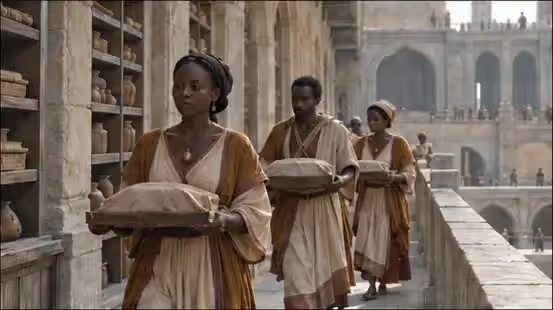
Deren Kal, a steward, with his tablets. At Marjory's bedside, the account tablets. Inside a cathedral granary: threshing floor and scribes.