

Culture
Arkhan’s knotted memory
Cords, songs and testimony preserve a memory travelling with people.
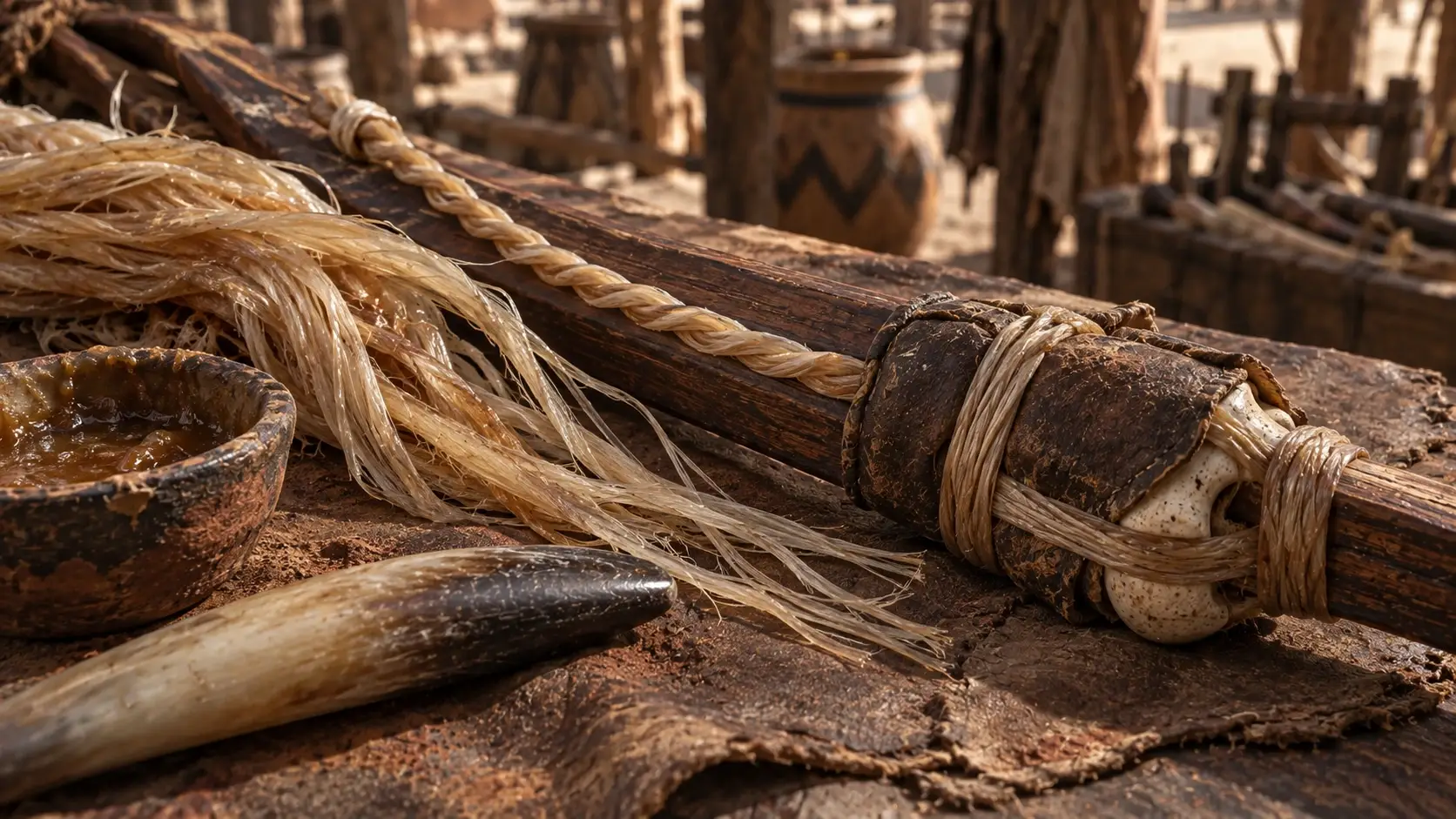
A support that follows the saddle
Saddle knots are a support for Arkhan memory. The cords accompany a people whose administration includes trails, reputation and recollection. They give a debt or lineage a portable object. Memory therefore does not depend solely on an archive building: it stays near travellers who know how to read the signs.
The hands of elders
In the Counting of Knots, children learn cords on elders’ laps while singers recite lineages and mount debts. Gesture and speech sustain transmission together. A cord alone and a song alone do different work: one carries a material sign, while the other preserves names and their order in shared memory.
Saying how one knows
Arḫán distinguishes knowledge from song, personal sight and reading a trace. The markers -an, -ek and -ur express these three relationships to knowledge. Reporting an observation and repeating collective memory offer different testimony. Trail, voice and knotted object provide different kinds of evidence.
What a cord is made of
A saddle cord begins as a two-ply thread of fine sinew, or as a steppe plant fibre for the humblest cords. It is dyed in the clan’s colours, and pierced bone beads that count the heads of the herd are threaded onto it. It is tied to the harness on the side from which the rider mounts, so that it can be touched without dismounting. A well-off family owns several cords, each for its own use: lineages, debts, beasts.
Cords wear out. Sinew dries and splits, and a cord left too long in the sun becomes brittle; it is therefore greased regularly, like a harness, and stored in a leather case during the rainy season. A remade cord keeps its knots in the same order: the cord-maker, often an old woman of the clan, copies it knot by knot before a witness, who touches the two cords one after the other.
Ribbons, engraved bones and maps
The cord is not the only support of knotted memory. Promises between two people are often sewn onto an oath ribbon, a band of Vüren velvet on which coded stitches state the commitment; it is worn at the wrist as long as the promise runs and cut when it has been kept. The pacts of the clans are kept on notched bones held by the Porte-Os, reminders of a chant that the witnesses know.
The roads have their bone maps: engraved plates showing the trails, the wells, the Apex territories and the migration corridors. A bone map is valid only if several witnesses have confirmed its content, and it is re-engraved before them when a well runs dry or a trail collapses. None of these objects is writing: they say nothing to anyone who does not know the chant, the promise or the country whose trace they keep.
False knots and real disputes
Secretly adding a knot to someone else’s cord is one of the most despised faults in Arkhan, worse even than stealing a beast. It is discovered more often than one might think. A recent knot does not have the same tension as the old ones; its fibre is less dry, its colour less faded; above all, no witness remembers seeing it tied. A cord is read with the fingers, but it is worth something only with living people who answer for it.
Disputes over cords are settled before the Porte-Os or before the clan elders. Each party brings its cord and its witnesses, and they are compared. The convicted forger must cut the false knot himself and return twice what he claimed to be owed; no cord is ever entrusted to him again, and from then on his debts are knotted on someone else’s, who answers for him.
A dead man’s cord, a foreigner’s word
When its bearer dies, the cord does not disappear. The debts it still carries pass to the heirs, who take them up knot by knot before witnesses, unless the creditors renounce them by cutting them. The knot of the name is detached and tied around the bone of the dead person placed at the door; the rest of the cord joins the cases of the Porte-Os, with the clan’s worn-out cords.
Foreigners soon learn that an Arkhan’s word is knotted. Volonian merchants trading at Port de Sable pay Arkhan witnesses to attend their agreements, and the clerks of Urnok, in the marches, copy onto their tablets the knots presented to them, without always understanding that a copy without a witness is worthless to an Arkhan. For a man of the trail, a contract is carried on oneself; a contract asleep in a chest is already half forgotten.