
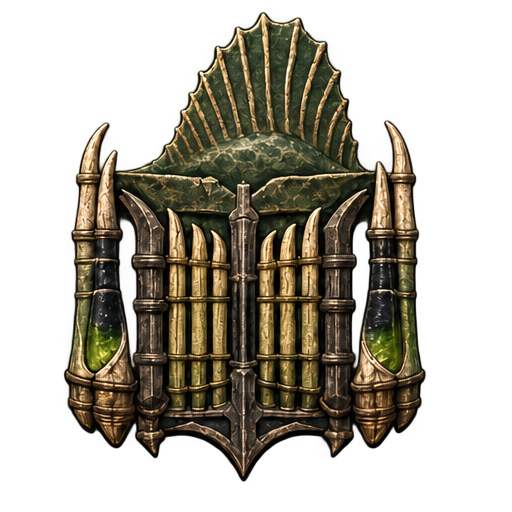
Power and institutions
N’Goro — Commandement et haute société
Audiences, décisions, inspections et rencontres privées : le pouvoir se lit dans la place donnée à chacun, dans les vêtements et dans l’organisation des salles.
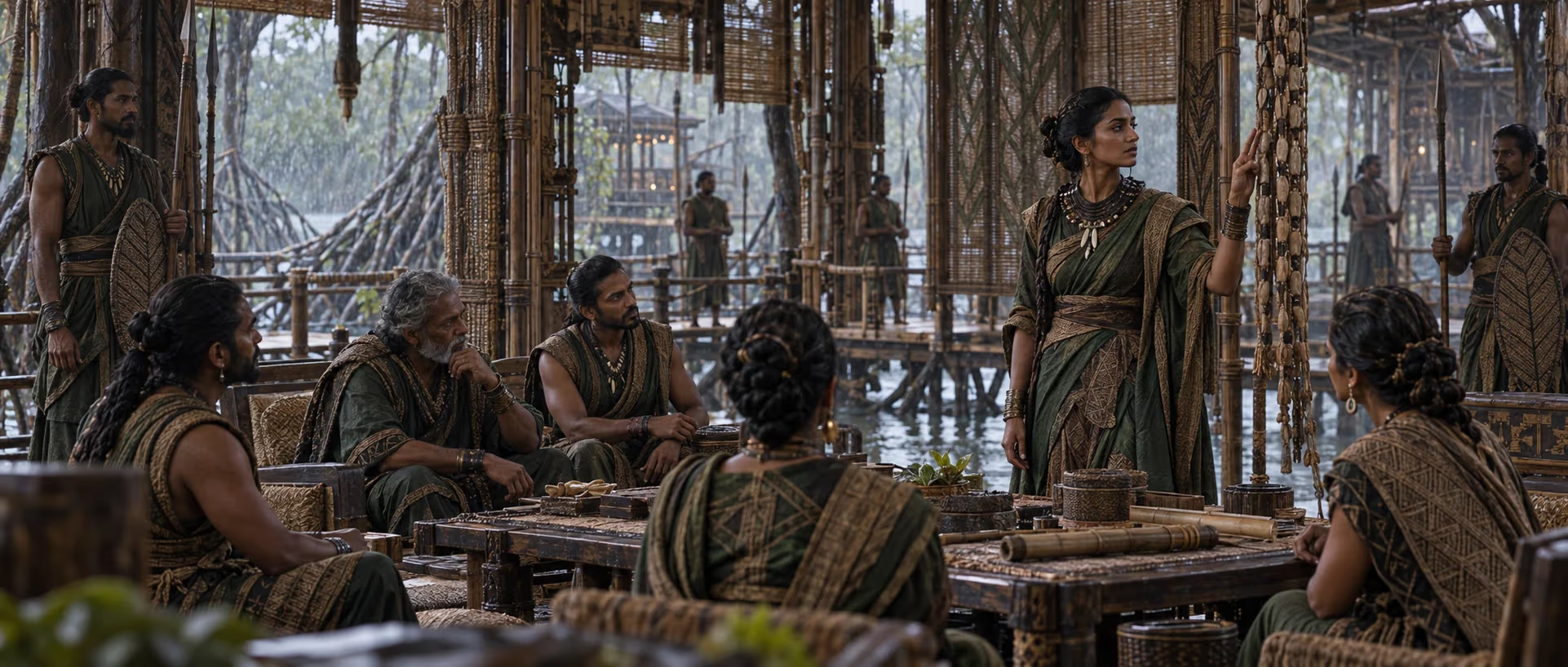
Dans les salles de décision
This extended reading is currently available in French.
Le Cercle des Équilibres, les Sèveurs et les institutions d’Yveth occupent des places différentes dans l’organisation de N’Goro. Décider signifie composer avec les seuils de circulation, les savoirs du marais et les responsabilités attachées aux passages. Un territoire humide ne se gouverne pas comme une route de pierre : le lieu et le moment conditionnent ce qui peut être déplacé, conservé ou admis. Les arbitrages relient la vie collective à ces limites matérielles.
L’autorité des Longues Ramures
Conservatoire d’Yveth · direction des routes vivantes.
Les tenues et les fonctions de chacun disent les institutions de la civilisation.
L’autorité en mouvement
Une revue, une réception ou une conversation de cour engage un rapport de force. Tout se joue au moment précis où l’espace, les gardes et les regards donnent un poids à la parole.
Une dette peut tenir un palais
Maisons du Lait Noir · haute société de protection et crédit.
The centre keeps recognitions
The Circle of Equilibria is an arbitration centre in Muu-Shanga. Registers, routes, recognitions, assemblies and negotiation between blocs form its function. It provides a central place for relationships crossing the country. Routes and affiliations meet in its arbitration work within an ultra-centralised power around Sûma.
A centre that commands
The Circle belongs to an ultra-centralised power around Sûma. The Insectophiles and the Houses of Black Milk form a clandestine opposition to this centre. The detail of the means the centre mobilises directly remains poorly known.
Passage involves several powers
The Sap-Keepers’ Synod can close routes through its health protocols. Carriers, canopy networks and animal holders possess other means of action. The Circle’s work sits among these complementary capabilities: a recognised route, a biologically usable passage and the means to travel it involve different actors. The Circle coordinates these capabilities on behalf of the centre.
Health opens or closes a route
The Sap-Keepers’ Synod oversees quarantines, antidotes, filters, inspections and protocols. It can close routes. In N’Goro’s waters and forests, this capability directly affects movement: a journey can exist on a map and become unusable for biological reasons. The health function thus becomes a concrete power over the movement of people, goods and animals.
A poison has a counterpart
Poison law requires a name, dose, signature, origin and antidote. A poison sold with a known antidote must have its counter-vial deposited with the Sap-Keepers. This duty connects dangerous material to the possibility of treating its effects. A biological product comes with a history and protection; its circulation involves more than the value of its contents alone.
A filter commits the community
Deliberately modified water must be marked. Hiding contamination is more serious than admitting an error, and lying about a filter is collective betrayal. Health trust therefore rests on information that must accompany products and passages. The Synod’s inspections and protocols operate in this culture where an admitted error still allows a response, while a lie exposes others.
Knowledge of the Long Boughs
The Yveth Conservatory is a field institution of the Long Boughs. Plants, spores, living wood, grafts, insects and ecosystem balance form its domain. Its working materials belong to N’Goro’s inhabited landscape. Knowledge therefore exists in contact with things that grow, change and respond, within an environment containing several levels of life.
Material that remains alive
N’Goro also builds with living wood, roots and vine networks. The Conservatory’s grafts and plants belong to this relationship with the environment: the supports of human life can continue to grow and depend on water, seasons or biological neighbours. Working with this material means following its living conditions as well as its shape.
Insects are part of the environment
Insects appear alongside plants and spores in the Conservatory’s domain. In Ngorian society they also participate in husbandry trades and in reading environmental changes. Ecosystem balance therefore connects several living forms: a plant, an insect or a useful material is understood together with the biological conditions surrounding it.
Arbitrer au nom du centre
Le Cercle des Équilibres réunit registres, routes, reconnaissances et assemblées au service d’un pouvoir ultra-centralisé autour de Sûma. Il peut appeler les maisons, les Sèveurs ou les détenteurs d’animaux à mobiliser leurs capacités. Les Insectophiles et les Maisons du Lait Noir y opposent une résistance clandestine.
Fermer une route peut protéger une communauté
Le Synode des Sèveurs dispose de la quarantaine, des filtres, des inspections, des protocoles et de la fermeture des routes. La santé publique agit ici sur la circulation : elle évalue des conditions de passage avant qu’un risque ne soit distribué à des personnes qui ne l’ont pas choisi. Le Synode adapte ses gestes de soin et de contrôle aux eaux, aux corps et aux routes concernées.
Une route doit être relue
Les cartes liquides combinent des couches de terrain et des signes biologiques ; elles peuvent devenir fausses avec le changement des eaux. Cette connaissance oblige les messagers, guides et décideurs à renouveler leurs preuves avant de promettre un itinéraire. Une carte n’est pas une garantie éternelle, mais une responsabilité d’observation.
The signs of rank
N’Goro scenes of power show neither crowns nor sceptres. Rank is read differently: in the place occupied near the water, in a hall laid out in a circle; in the sap-stained hands of those who prepare; in the number and material of the flasks worn at the belt; in carapace tattoos that only show with heat. Guards wear arthropod carapace plates lacquered with sap, shields of black wood and the centipede-spiral badge.
The palette is the nation’s own: sap green and deep green over a ground of ash, peat ochre and bleached bone, with the pale glow of lichens and fireflies. Women occupy the foreground of decisions, in a country where military command most often falls to them. The faces are those of N’Goro’s South Asian population, and the clothing remains that of a wet world: fibres, bark cloth, oiled leathers, chitin and resin.