
Les Griffes de Ramure
Trois gestes au cœur de la canopée : prendre appui, traverser le vide, croiser sa chute. Les Griffes de Ramure prolongent le bras par trois appendices liés à une attelle d’avant-bras.
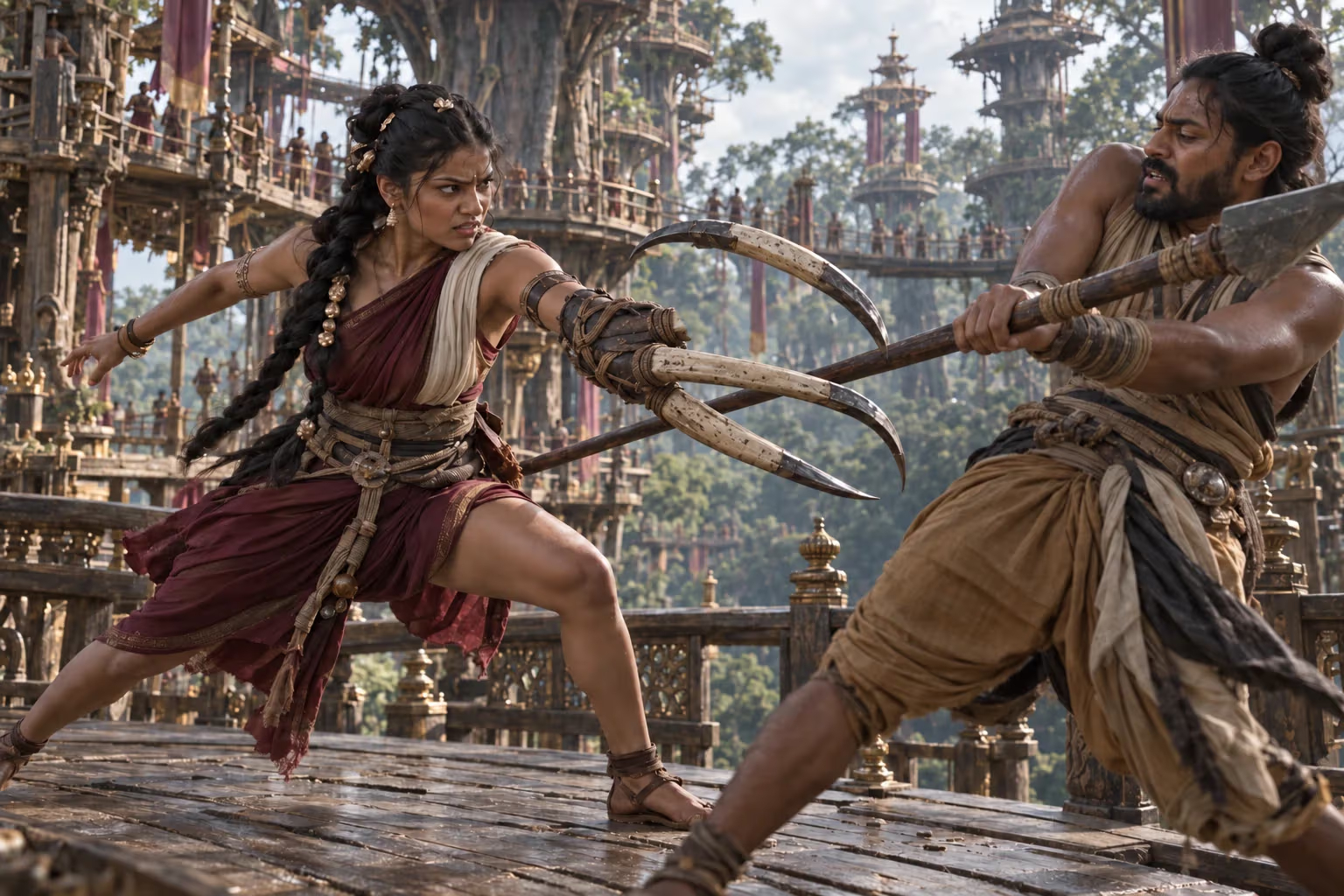
La prise, le balancier, la chute
Bois creux, os, tendons et cuir structurent le dispositif. La prise, le balancier et la chute croisée servent dans des situations différentes, à hauteur du corps comme au-dessus des passerelles.
La Chute Croisée
Hautes Jungles · Assaut depuis le dessous.
A weapon worn along the whole forearm
The Griffe de Ramure is a giant gauntlet. It covers the hand, the wrist and the forearm up to the elbow, and extends the fist with three long curved prongs about a metre each, slightly spread and ending in a point. Seen from afar, it looks absurdly massive; worn, it remains surprisingly light.
That is where the genius of the object lies. The prongs are not metal bars, which would be too heavy and would wrench the wrist. Each has a hollow core of very hard wood, reinforced with long bone ribs and tensioned tendons; leather wraps the hand and arm; metal is found only on the edges, the points and the areas of wear. The main support runs up to the elbow, so that the load taken by the claws spreads through the whole forearm instead of bearing on the wrist.
A Griffe is made to measure. The craftsman takes the length of the arm, the strength of the grip and the way the fighter closes the elbow, and he reworks the brace as long as the weapon shifts against the skin. A fighter rarely changes Griffe in the course of a life; it is repaired, a rib or a point is replaced, and in the end it carries the marks of all its years.
Why three claws
The shape of the weapon comes from an animal. The canopy therizinosaurid, the great beast of the High Jungles, has three huge curved claws on each hand, with which it grasps branches, pulls down foliage and hauls itself up along the trunks. The people of the heights have always lived beside those hands, and the fascination with the three claws is everywhere in their art: on the sculptures of the palaces, on the guardians’ insignia, in the gestures of the dances.
Yet the Griffes de Ramure are not made of real claws. A metre-long claw taken from a dead animal is a rare and precious piece: it serves as a ceremonial sickle and as the guardians’ insignia, and is seldom sold. The fighting weapon imitates the shape without taking the material.
It also answers a belief. In the High Jungles, the ground is held to be impure: people live, farm and fight in the heights, and touching the ground is a risk as much as a disgrace. A weapon that lets you hook on anywhere, catch a fall and never come down could only have been born there.
The Grip, the Swing and the Crossed Fall
On a liana, a fighter can drive the three claws around the fibre without cutting it, then close the arm: his weight then passes into the gauntlet. He can hang by one hand, free both legs, gather momentum, pivot, let go and hook another liana ten metres further on. The martial art that follows is part boxing, part trapeze, part grappling hook, and it rests on three techniques every pupil learns.
The Prise de Ramure, the Canopy Grip, is the first. The three prongs close around the opponent’s forearm or weapon; the fighter turns his body, and the other either lets go of the weapon or goes over the edge with him. The Balancier, the Swing, is the most spectacular: one Griffe stays fixed to the liana, the body passes beneath the anchor point, and the other arm strikes with all the speed of the pendulum.
The Chute Croisée, the Crossed Fall, is the most feared. The warrior deliberately lets go of his platform and drops; one Griffe catches a liana lower down, his body changes direction abruptly, and the other arm strikes from below, where a fighter used to the ground expects no attack. A foreigner who sees a man throw himself into the void for the first time, only to come back from underneath, never forgets it.
Learning above the void
No one learns the art of the Ramure in a courtyard. The schools set up on the wooden galleries that ring the great trunks, with practice lianas stretched at low height above woven nets. Children start without a weapon, through games of hanging and balance; around the age of twelve they are given a training Griffe with blunted points, shorter and lighter than the fighting weapon.
The first year is almost entirely given over to the Grip and to the art of letting go. The master judges a pupil by the way he falls, not by the way he strikes: one who always catches a liana beneath him can learn the rest. Then comes the Swing between two galleries, and, years later, the Crossed Fall, which is taught only to pupils the master answers for personally.
Accidents are rare but serious, and the schools hide them badly. A fall all the way to the ground is the worst outcome, worse even than injury: whoever has touched the underneath must be purified before climbing back up among his own. Accomplished fighters wear a cord knotted at the wrist for every fall caught from very high, and some old masters have so many that they cover the brace.
In war
In war, the Griffe de Ramure is not the weapon of a battle line. It belongs to the fighters who hold the Portées and the Nœuds, the great suspended links of the High Jungles and their junctions. A foreign force that ventures into the canopy finds an enemy that attacks it from above, from below and from the side, and vanishes into the foliage before anyone can take aim.
Against Arkhan, whose tracks seek to open the forest, this way of fighting is decisive. Riders can cross the ground; they cannot follow their opponents into the heights, and a column halted beneath the treetops becomes a target. The people of the High Jungles say they can close a jungle and make an army disappear, and the Griffe de Ramure is one of the means of that promise.
Its limits are well known. Outside the canopy, on open ground or a stone wall, the weapon loses most of its value, and the fighters of the heights refuse to fight there. The foreigners who have tried to copy the Griffe have nearly all failed: without the lianas, the galleries and ten years of schooling, all that is left is a cumbersome gauntlet.