
Orlantis
Forest duchy: timber, resins and Lines.
Families, workshops, roads. A duchy can be read in what it makes.
Enter the LinesDuchy of Urnok
Ducal House Voranis
The Lines of Orlantis
In Orlantis, a Line is a family entered in the duchy’s Register of Trades. It answers for a link in the chain: from felled timber to a turned pulley and the port that ships it.
Prestige comes later. First, one must know whose door to knock on when a part fails.
The timber chain to the port
Choose a Line to follow its work.
Functional diagram, without scale or geographical positions. Culorn: a forest function, not a mapped location.

TolmenJoinery & turning
Everything rests on a true fit.
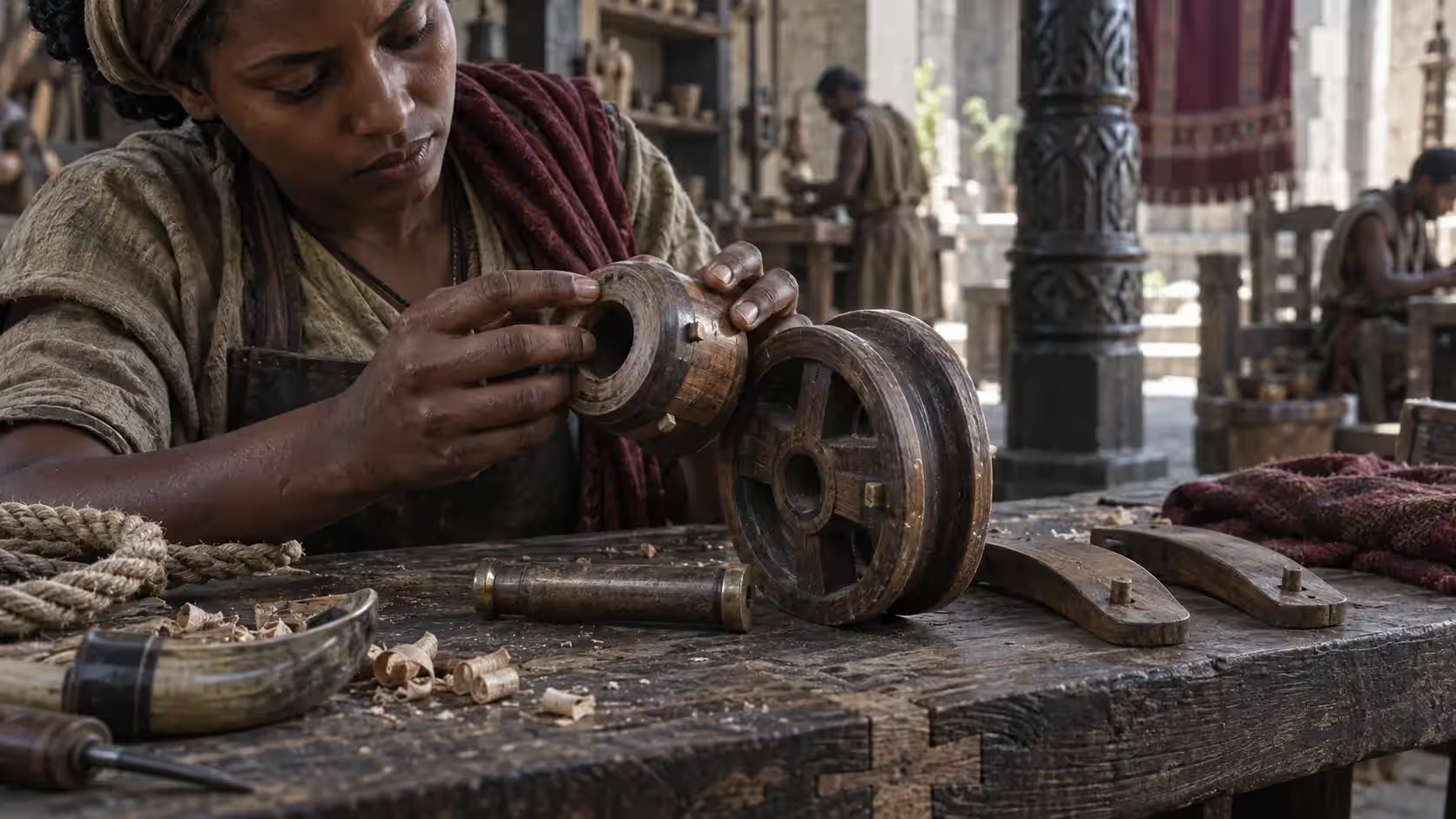
Hubs, axles, pulleys and calibrated parts: the Tolmen line works the details that make movement possible. Its chain joins fine joinery with turning.
- In the duchy
- After the drying sheds and steam rooms, before the tall spaces of the carpenters.
- What passes through their hands
- Hubs, axles, pulleys, calibrated components.
When a hub breaks, its record leads back to the line responsible for it.
Le moyeu demande sa matière
Le tournage fournit la pièce ; son entretien demande aussi des matières de graissage. Une scène de maintenance, en complément du travail des Tolmen.
Orlantis work sites
Working places, from the basin to the forest.
Orlantis — le soin des plaques
Depuis une plateforme, une soigneuse nettoie les plaques d’un stégosauridé. Les bassins et les dégagements appartiennent à la ceinture de soin du vivant, à l’écart des passages encombrés.
Pools and plate care
Thermal gardens can combine baths, a civic garden and a veterinary centre. Ramps, drains, non-slip surfaces, inspection platforms, brushes and ointments make care possible.
These labels describe functions. They introduce no new city names or geographical coordinates.
Stegosaurids, timber and resin
Imperial stegosaurids belong exclusively to Orlantis. The Lomvar line handles breeding, training and harnessing: the duchy’s emblem also depends on a family of skilled workers.

Bringing out the timber
Logging brings timber out of the forest. Training, harnessing and forest access form a continuous chain, distinct from the power of House Voranis.
Giving care
Water, fodder, rest, inspection and cleaning accompany movement. Plate care uses veterinary pools, platforms, brushes and ointments.
Leaving room
Routes bypass the centre. Courts need broad turning spaces; pedestrians have refuges and stay clear of the armed tail’s reach.
Materials and intermediate products
Beneath the great chains, other Lines make what allows objects to exist. An adhesive. A fibre. The ink in a register.
Orlantis’s intermediate productsCorvelGlues & adhesives
Resin, tendon and ash support joints, veneers and fletched arrows.
- Input
- Resin, tendon, ash
- Output
- Glues and adhesives
- What depends on it
- Joints, veneers and fletched arrows
NalenCordage & fibres
Hauling and rigging depend on them, all the way to Velmor’s anti-air nets.
- Input
- Fibres
- Output
- Cordage
- What depends on it
- Hauling, rigging and Velmor’s anti-air nets
OmbrinLampblack & pigments
A forest material becomes the ink in imperial registers.
- Input
- Lampblack and pigments
- Output
- Materials for ink
- What depends on it
- Imperial registers
TanorisBark tannins
Bark feeds tanneries, then leather and harnesses. This registration is separate from the Tanoris of Sarnor.
- Input
- Bark
- Output
- Tannins
- What depends on it
- Tanneries, leather and harnesses, reaching Velmor


Materials moving between duchies
Follow a material beyond Orlantis.
Orlantis · bark
The Tanoris line supplies bark tannins to the tanneries.
Velmor · harnesses
Leather becomes Velmor’s black harnesses: a forest product equips a living animal elsewhere in the Empire.
Bralnor · stone
A Bralnor sauropod wears the harness and pulls stone for a construction project.
Sarnor · grain
The project is paid for in Sarnor grain; its funding depends on another duchy in turn.
Orlantis · ink
The register accounting for the whole chain uses ink made from Ombrin’s materials.
Houses and Lines of Orlantis
House, High Line, Line, Short Line: four scales for understanding Urnok’s families. Their links can be read in supply chains, registers and generations.
House
A duchy or an imperial function.
High Line
A chain, from material to finished product.
Line
An intermediate product; one precise link.
Short Line
A workshop, a lifetime; not inheritable.
Architecture, animals and safety
Water flows. Timber dries. Resin burns. Every constraint leaves a form in the city.
Building in fine timber
Lacquered teak and ebony, resin, oiled hide and worn gold. Plate roofs form one regional language among several, used in palaces, markets, halls and relay stations.
Making room for the living
Stegosaurid enclosures remain on the periphery. Roads give them direct forest access and turning spaces; their tails require safe distances.
Keeping fire apart
Resin cooking takes place beyond the walls, downwind. Drying sheds, tall workshops and quays follow the progress of the material.
Orlantis public rules
Places, families, materials and large animals are understood through the responsibilities that connect them.
An address of responsibility
A Line is a continuous entry in the Register of Trades. When a part breaks, the register identifies the family responsible for that link.
Four levels of work
A House holds a duchy or an imperial function; a High Line holds a production chain; a Line supplies an intermediate product; a Short Line holds a workshop that cannot be inherited. The structure also allows slow, costly mobility through legal records.
The district is a link
The city reads from upstream to downstream. A district reveals a trade, an income, a vocabulary and a smell; an interruption in the drying sheds eventually reaches the carpenters.
Living animals shape their routes
Stegosaurids bypass the centre, cooking sites remain outside the walls and cargoes rest on raised bases. Drinking troughs, refuges and turning pockets are part of the architecture.
The right part, with the world’s materials
Timber, leather, fibre, rope, resin and small bronze parts support wheels, axles and carts. Roads and terrain determine the transport method; heavy loads retain their skilled workers and constraints.